
Thickness Comes First
Heat travels from the outside toward the center, so maximum thickness is far more useful than package weight for sous vide timing.
SOUS VIDE MADE SIMPLE
Choose your protein, cut, thickness, preferred texture and starting state. We’ll calculate a practical sous vide temperature, minimum cook time, ideal cooking window and finishing plan built around the meat—not a one-size-fits-all chart.
Start with the meat itself. The available cuts and texture choices update automatically.
Choose the cut, thickness and texture you want, then build your cook. The result separates the safety minimum from the longer window that may be needed for the texture you actually want.
YOUR COOKING PLAN
WHY THE CLOCK CHANGES
A tender steak mostly needs enough time for heat to reach the center and, when applicable, complete the required time-at-temperature pasteurization. A collagen-heavy roast may need many additional hours after that point before it becomes tender.
Heat travels from the outside toward the center, so maximum thickness is far more useful than package weight for sous vide timing.
Lower sous vide temperatures can require longer holding times. The calculator builds that time into supported meat and poultry selections.
Chuck, brisket, ribs and shoulder can be safe long before they are tender. Their recommended windows account for the texture stage too.
THE SOUS VIDE SYSTEM
Sous vide is precise because the water bath controls temperature, but temperature alone does not tell you when the food is ready. The cut, thickness, starting state and holding time all change the cooking plan. That is why this calculator uses more than a single temperature chart.
A steak cooked in a 131°F bath behaves very differently from one cooked at 140°F. The water temperature controls the highest temperature the meat can gradually approach, which is what makes edge-to-edge doneness possible.
The center of a thick steak takes longer to heat than the center of a thin one, even when both pieces weigh the same. Measure the thickest point of the food instead of relying on package weight.
Once the center is hot, additional holding time can serve a different job. It can complete a time-at-temperature pasteurization step or slowly soften collagen in chuck, ribs, brisket and shoulder.
The water bath cannot create the browned crust people expect from steak or chops. Dry the surface extremely well, then finish hot and fast in cast iron, on the grill or on a flat-top griddle.
KEEP THE SETUP SIMPLE
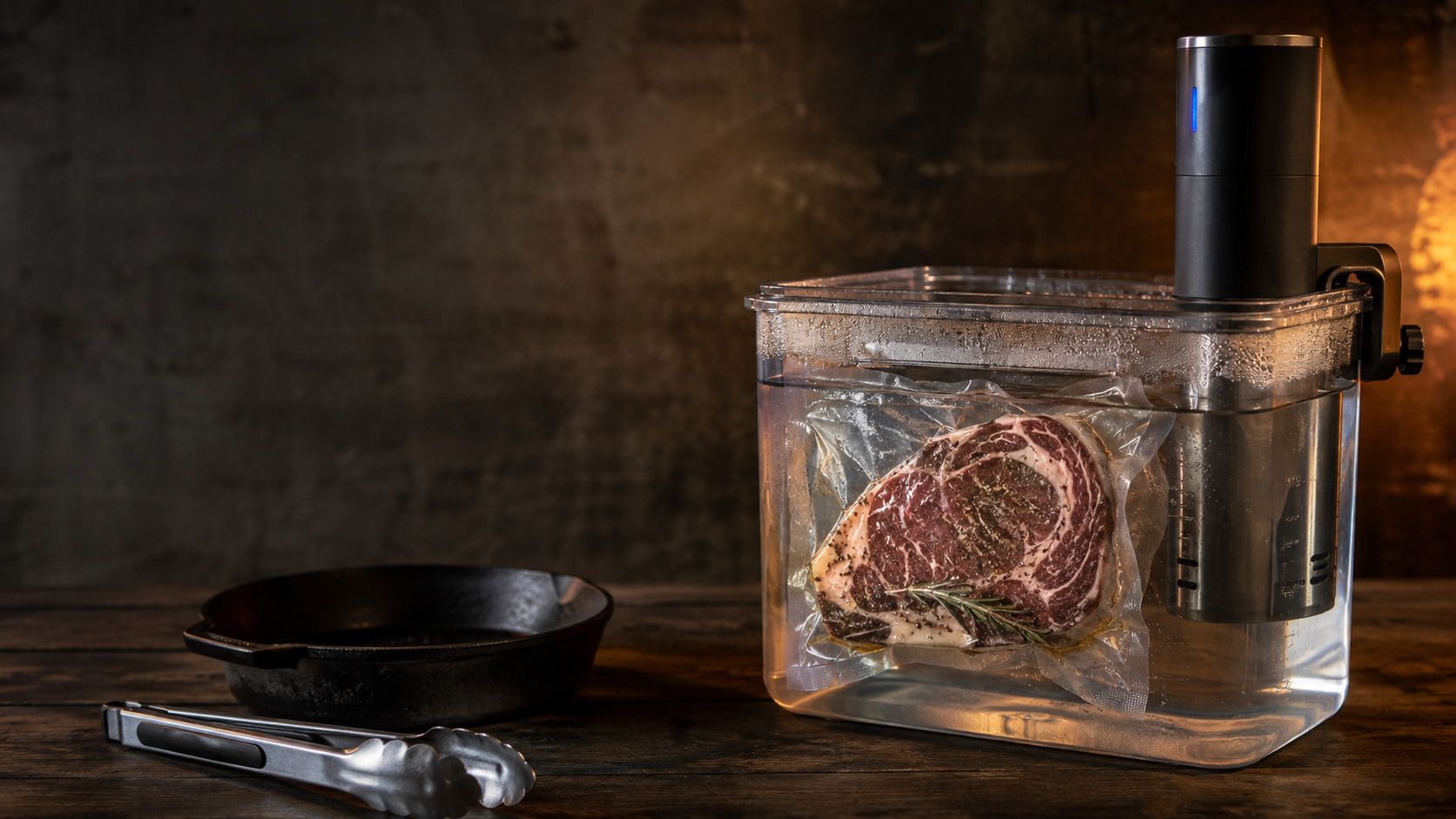
You do not need a countertop full of specialty gear. A reliable immersion circulator, a container that lets water move freely around the bag, a dependable sealing method and something hot enough to create a fast finish will handle most home cooks.
This is the sous vide cooker itself. Look for stable temperature control, enough power for the container size you normally use and controls you will actually use without fighting an app every time you cook.
Compare sous vide cookers on AmazonA stockpot works, but a dedicated container gives bags more room and a fitted lid helps reduce evaporation during long cooks. Leave enough open space for water to circulate around every bag.
Shop sous vide containersA vacuum sealer is convenient for batch prep and long cooks, but it is not mandatory for every meal. Sturdy zipper bags and the water-displacement method work for many everyday sous vide cooks.
Compare vacuum sealers and bagsA heavy skillet stores enough heat to build a fast crust without leaving the meat in the pan forever. A simple Lodge-style cast iron skillet is more useful here than a pile of specialized finishing gadgets.
Shop cast iron skilletsKEEP BUILDING THE SYSTEM
Sous vide works best when it is part of a bigger cooking system: understand temperature, verify with the right thermometer, and use a high-heat finish when the food needs browning.
SOUS VIDE QUESTIONS
These are the questions that usually matter once you move beyond “what temperature should I use?” and start paying attention to thickness, texture and the final sear.
For sous vide, maximum thickness and shape control how long heat takes to reach the center. Two steaks can weigh the same but require different heating times if one is much thicker than the other.
Yes, for the supported selections. Choose Frozen and the calculator adds a conservative heating allowance before the recommended cooking window. Keep bags separated so water can circulate around the entire portion.
Yes. The food usually will not overshoot the bath temperature, but texture can continue changing. Tender steaks can become unusually soft or lose the bite you wanted if held far beyond their useful window. That is why the calculator includes a “Do Not Push Past” guideline.
No. Vacuum sealing is convenient, especially for long cooks and meal prep, but sturdy food-safe zipper bags can work for many home cooks. Use the water-displacement method to remove trapped air and keep the bag opening above the water line when appropriate.
For the timing model used here, start with the bath at the selected target temperature. Adding cold or frozen food may temporarily lower the bath temperature, so use enough water and a circulator that can recover and maintain the target.
The minimum is the calculator's thickness-and-temperature floor for the supported intact cut or poultry portion. The best-texture window can be longer because connective tissue, fat and the character of the cut continue to change with additional time.
This version intentionally does not extrapolate past the published thickness range used by its safety model. Portion the meat into sections no thicker than 2.75 inches, or follow a tested process specifically validated for the larger cut.
The water bath cooks evenly but does not create the dry, high-surface-temperature conditions needed for strong browning. Pat the food very dry and sear briefly over high heat so you build crust without spending enough time there to overcook the center.
This calculator is designed for cook, finish and eat service. Cook-chill sous vide adds separate rapid-cooling, reduced-oxygen packaging and cold-storage controls, so those storage calculations are intentionally not included here. Review the FDA guidance linked above before building a cook-chill workflow.
FROM OUR BACKYARD TO YOURS
Use the calculator as the starting plan, keep the bag surrounded by circulating water, and let the final sear do the work the water bath cannot.

Get approachable recipes, practical BBQ tips, and helpful guides delivered straight to your inbox.
JOIN THE COMMUNITYGet new recipes, practical backyard cooking tips, gear recommendations, and subscriber-only updates delivered straight to your inbox. Plus your free Temp Guide.
No spam. Just useful backyard cooking content. Unsubscribe anytime.
